
9 European Hotels Hidden Inside Old Prisons, Monasteries and Train Stations
Some of the most interesting hotels in Europe were not built to be hotels at all. They started life as prisons, monasteries, train stations, banks or embassies — buildings designed for completely different purposes, then carefully converted into places to sleep once their original roles ended. The result, when it works, is architecture you can actually stay inside. Exposed jail cells behind your hotel-room door. A monastery courtyard at breakfast. A medieval cloister turned into a reading lounge.
The hotel industry now has a name for this: salvaged stays. Here are nine of the best in Europe, from Istanbul to Amsterdam, Helsinki to the Loire Valley.
Former prisons
1.Four Seasons Hotel Istanbul at Sultanahmet, TurkeyView on Booking.com ↗
Location: Sultanahmet, Istanbul
Price: Luxury
Originally: Sultanahmet Prison, opened 1918
The Four Seasons Sultanahmet occupies the first modern prison built by the Ottoman Empire. Designed by Mimar Kemaleddin Bey in Turkish neoclassical style and completed between 1918 and 1919, it was intended as a state-of-the-art facility and mostly held intellectual dissidents — journalists, writers and poets. Several Turkish literary classics were written inside these walls, including Nazım Hikmet's epic Human Landscapes from My Country and Orhan Kemal's novel Ward 72. The prison closed in 1969 and the building was carefully restored as a Four Seasons, opening in 1996. The location could hardly be better, a couple of minutes on foot from Hagia Sophia and the Blue Mosque.
2.Malmaison Oxford, UKView on Booking.com ↗
Location: Oxford Castle complex, Oxford
Price: Mid-range to upper mid-range
Originally: HM Prison Oxford, within Oxford Castle (castle 1071, prison 1888 to 1996)
Malmaison Oxford sits inside the medieval Oxford Castle complex, which dates to 1071 and was used as a gaol for centuries before officially becoming HM Prison Oxford in 1888. The prison finally closed in 1996, and after a restoration part-funded by the Heritage Lottery Fund the building reopened as a hotel in 2006. The conversion is distinctive — many of the guest rooms are built from actual former cells, with original cell doors, peepholes, heavy locks, Victorian ironwork and exposed brick preserved throughout. It is one of the few places where "sleeping in a prison cell" is genuinely accurate, not just marketing.
3.Hotel Katajanokka, Helsinki, FinlandView on Booking.com ↗
Location: Katajanokka district, Helsinki
Price: Upper mid-range
Originally: County prison and pre-trial detention centre (oldest parts 1837, main building 1888)
Hotel Katajanokka has been called Finland's most notorious former prison. The oldest sections of the building date from 1837 and the main structure from 1888, and it functioned as a county prison until 2002. It reopened as a hotel in 2007 and was refurbished again in 2017, now sitting under the Marriott Tribute Portfolio with 106 rooms. Former cells have been converted into Nordic-design rooms with sauna access — a rare touch in a prison hotel. Two original cells are kept in the basement as a small museum, including an isolation cell and the former prison chapel.
4.Het Arresthuis, Roermond, NetherlandsView on Booking.com ↗
Location: Historic centre, Roermond
Price: Upper mid-range to luxury
Originally: Dutch detention centre, 1863 to 2007
Het Arresthuis is an elegant example of what adaptive reuse can do when done carefully. The building operated as a prison for almost 150 years and closed its doors in 2007. After two years of renovation it reopened in 2011 as a Van der Valk hotel, and in 2018 it became the chain's first five-star property. The clever bit is that three former cells were combined to make each guest room: one cell is now the bedroom, the second is a sitting area, and the third is the bathroom. The four top suites are named The Jailer, The Lawyer, The Director and The Judge.
Former monasteries and abbeys
5.Fontevraud L'Hôtel, Loire Valley, FranceView on Booking.com ↗
Location: Fontevraud-l'Abbaye, Anjou
Price: Luxury
Originally: Priory of Saint-Lazare within the Royal Abbey of Fontevraud, founded 1100
The Royal Abbey of Fontevraud was founded in 1100 as a double monastery where monks and nuns lived side by side. Eleanor of Aquitaine spent her final years there, and she, King Henry II of England and their son Richard the Lionheart are all buried in the abbey church. The hotel occupies the former Priory of Saint-Lazare, where in the Middle Ages the sisters cared for the sick and the leprous. The conversion opened in 2014 after a years-long restoration by architect Sanjit Manku and designer Patrick Jouin. The fifty-four rooms sit in former dormitories, duplexes and attics, and the hotel restaurant has earned a Michelin star and three Gault et Millau chef's hats under chef Thibaut Ruggeri.
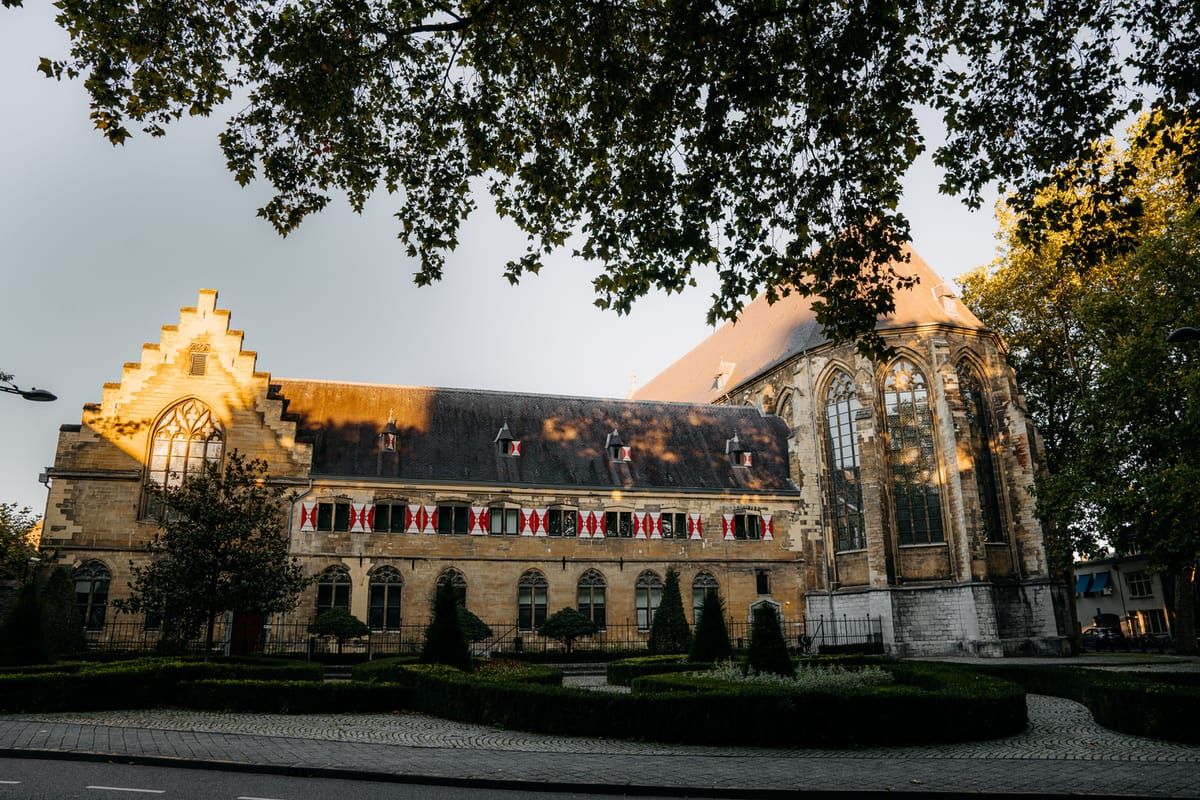
6.Kruisherenhotel, Maastricht, NetherlandsView on Booking.com ↗
Location: Historic centre, Maastricht
Price: Upper mid-range to luxury
Originally: Crosier Monastery (Kruisheren Klooster) of the Order of the Holy Cross, built 1440 to 1520
Kruisherenhotel is the second Dutch entry on this list, and the reason is simple — very few countries are as comfortable converting Gothic monasteries into design hotels as the Netherlands. The Crosier Monastery was built between 1440 and 1520 by the Order of the Holy Cross, a community of monks who wrote, bound and copied books. Monks lived there until 1797. After two centuries serving as a barracks, an agricultural research station and a temporary parish church, the city of Maastricht sold the complex to hotelier Camille Oostwegel in 2000. The restoration used Dutch designer Henk Vos and German lighting artist Ingo Maurer, and the hotel opened in 2005 with sixty rooms spread across the monastery and its Gothic church.
Former train station
7.St Pancras Renaissance Hotel London, UKView on Booking.com ↗
Location: King's Cross / St Pancras, London
Price: Luxury
Originally: Midland Grand Hotel at St Pancras station, 1873
The St Pancras Renaissance Hotel occupies most of the original Midland Grand Hotel — the soaring red-brick Gothic Revival building designed by George Gilbert Scott that opened in 1873 directly next to St Pancras station. It closed as a hotel in 1935 and spent decades as railway offices for British Rail, who at one point wanted to demolish it. The building survived because of a high-profile campaign led by Jane Hughes Fawcett of the Victorian Society, and in 1967 both the hotel and the station received Grade I listed status. After a vast restoration it reopened as the 244-room St Pancras Renaissance Hotel London in 2011 under the Marriott Autograph Collection. The grand staircase and the exterior spires are among the most photographed hotel features in London.
Former bank and music school
8.Conservatorium Hotel, AmsterdamView on Booking.com ↗
Location: Museum Quarter, Amsterdam
Price: Luxury
Originally: Rijkspostspaarbank savings bank (1897), then Sweelinck Music Conservatory
The Conservatorium has two different former lives. The building was originally designed by Daniel Knuttel in 1897 as the Dutch national savings bank, the Rijkspostspaarbank. When the bank moved out in the late 1970s, the building was taken over by the Sweelinck Music Conservatory, which taught inside it until 2008 when the school moved near Central Station. That same year The Set bought the building and commissioned Italian architect Piero Lissoni to design the conversion. It opened as the Conservatorium Hotel in 2011. Design touches hint at both former lives: the venue that now houses the Taiko restaurant was once the percussion and drum classroom, and in the hallways you can still see original piggy-bank tiles from the building's bank days.
Former embassy
9.SO/ Berlin Das Stue, GermanyView on Booking.com ↗
Location: Tiergarten, Berlin
Price: Luxury
Originally: Royal Danish Embassy, built 1938 to 1940
Das Stue (Danish for living room) was built between 1938 and 1940 by the German architect Johann Emil Schaudt, who also designed the legendary KaDeWe department store. The building served as the Royal Danish Embassy in Berlin for thirty-eight years and was then sold by Denmark in 1978. It passed through several uses, including an executive training venue for Deutsche Telekom, before finally opening as a hotel in 2009 after a major renovation by Axthlem Architects, who added a modern wing. The hotel sits right next to Berlin Zoo, with views over the Tiergarten, and is one of the most design-forward conversions on the list.
A few things to know before you book a salvaged stay. These hotels are almost always in protected heritage buildings, which means quirks are baked into the experience — unusual room shapes, preserved features you cannot touch and sometimes smaller or oddly proportioned spaces. Plan for character, not cookie-cutter. And read the hotel's own history page before you go, because part of what you are paying for is knowing the story of the building you are sleeping in.
Not sure which one to pick? Try our AI chatbot on the homepage — tell it your destination and we'll help you narrow down the right salvaged stay for your trip.
If you are hunting for more unusual places to sleep, we also have guides to the best desert hotels in the world, the best traditional riads in Marrakech and the cosiest boutique hotels in the Scottish Highlands.
Ready to book your trip? Let Goatodeer find the best hotels and flights for you.
Start your trip →