
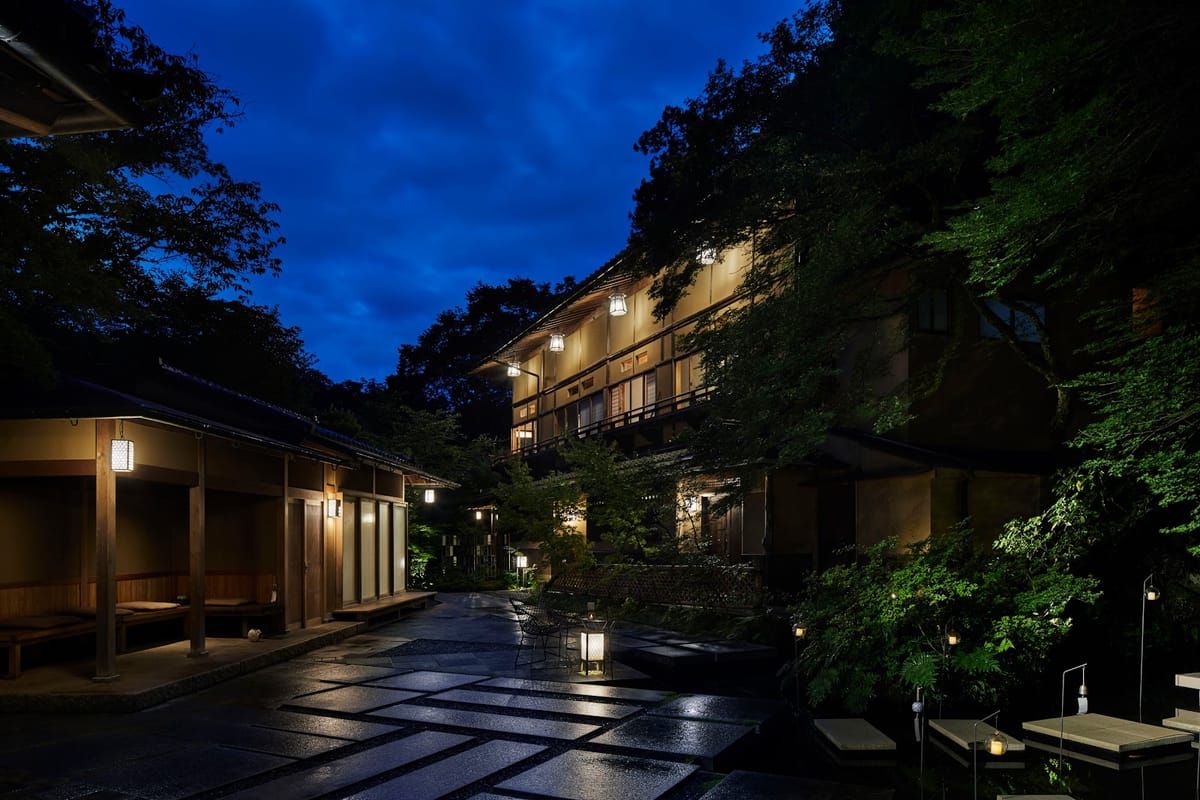
8 Japanese Ryokans Where Silence Is the Main Amenity
Ryokans are the opposite of loud. A proper Japanese ryokan is built around tatami floors, sliding shoji doors, a private or shared onsen, and the kind of service that aims to make itself invisible. You walk in, your shoes come off, a kimono-clad host escorts you to a room where tea is already set. Silence is not an amenity you have to ask for. It is the default setting of the whole experience.
Which is why Japan is the country that taught the world how to do what 2026 travel reports now call "hushpitality" — hotels built around deep rest. Here are eight verified Japanese ryokans where the entire experience is designed around silence, slow meals and the idea of a room you do not really want to leave.
1.Nishiyama Onsen Keiunkan, YamanashiView on Booking.com ↗
Location: Hayakawa, Yamanashi Prefecture
Price: Upper mid-range to luxury
Keiunkan is the oldest hotel in the world, full stop. Founded in 705 and certified by Guinness World Records as the world's oldest continuously operated hotel, it was run by fifty-two generations of the same family for over 1,300 years until the family line ended in 2017, and it continues to operate under new ownership today. It sits at the foot of the Japanese Alps in western Yamanashi, has thirty-seven guest rooms with views of the surrounding mountains and the Haya River, and features six hot springs — four outdoor and two indoor. Since 2005, private free-flowing hot spring baths have been added to every room. For historical weight alone, it is the single most remarkable ryokan in Japan.
2.Tawaraya, KyotoView on Booking.com ↗
Location: Central Kyoto
Price: Ultra-luxury
Tawaraya is widely considered the finest ryokan in Kyoto, and by extension, in Japan. It is around three hundred years old and represents the wabi-sabi aesthetic in its purest form — the gentle patina of age treated as the highest mark of beauty. Staying at Tawaraya is less a hotel transaction and more an invitation into a very old Kyoto family home. Rooms are small, perfect and impossibly quiet; meals are personal kaiseki served in-room; service is minimal because it is anticipatory rather than reactive. It is also genuinely expensive — firmly at the ultra-luxury tier — but for a single unforgettable ryokan experience, this is the one.
3.Hoshinoya Kyoto, ArashiyamaView on Booking.com ↗
Location: Arashiyama, western Kyoto
Price: Luxury
Hoshinoya Kyoto is the modern luxury interpretation of the traditional ryokan. Its twenty-five rooms are distributed across low-profile buildings along a secluded arm of the Oi River in Arashiyama, fifteen minutes upstream from central Kyoto. The only way to check in is by a private traditional wooden boat from the river, which tells you everything about how the property wants to position itself. Rooms are designed by architect Rie Azuma with river views from every window. Zen meditation and morning stretching are offered as group programmes, and the Kura building — literally a traditional storehouse — is set aside as a silent retreat for reading and writing. Dinner is kaiseki.
4.Hoshinoya Tokyo, OtemachiView on Booking.com ↗
Location: Otemachi, central Tokyo
Price: Luxury
Hoshinoya Tokyo is what happens when you take a traditional countryside ryokan and reimagine it for the centre of Tokyo. It occupies a discreet seventeen-storey high-rise in Otemachi, where each floor functions as its own self-contained ryokan with six private rooms behind sliding shoji doors, a communal lounge and a shoes-off policy. Wellness programming includes indoor and outdoor onsen, forest bathing experiences, traditional Japanese spa treatments and kaiseki cuisine inspired by Kyoto's historic culinary traditions. For travellers who want the ryokan experience without leaving Tokyo, this is the best option in the city.
5.Gora Kadan, HakoneView on Booking.com ↗
Location: Gora, Hakone
Price: Luxury
Gora Kadan occupies the former summer villa of Japan's imperial family in Hakone's forested mountains, about ninety minutes from Tokyo by train. Many rooms feature private open-air baths supplied directly by the Hakone volcanic hot springs, which means you can slip from a cedar-walled bedroom straight into a steaming outdoor pool without ever crossing the property. Hakone is the most convenient "first ryokan experience" for travellers flying into Tokyo because you can reach it in a morning, and Gora Kadan is the anchor property in the region for a reason.
6.Beniya Mukayu, Yamashiro OnsenView on Booking.com ↗
Location: Yamashiro Onsen, Ishikawa Prefecture
Price: Luxury
Beniya Mukayu is a small sixteen-room ryokan on the lesser-known hot spring coast of Ishikawa Prefecture. Every room has a private open-air bath, and the design emphasis is on minimalism and organic materials — a deliberate expression of the belief that simplicity, reflection and connection with nature are themselves restorative. This is the ryokan to book if you are after genuine contemplation rather than the more famous destinations of Kyoto and Hakone, and if you want a quieter side of Japan.
7.Kyoto Nanzenji Garden Ryokan YachiyoView on Booking.com ↗
Location: Nanzenji Villa District, Kyoto
Price: Upper mid-range to luxury
Yachiyo has been operating since 1890 in Kyoto's Nanzenji Villa District, a quieter part of the city wrapped around the Nanzenji temple complex. The property is built of wood and paper in the classic ryokan style, with traditional Japanese rooms opening onto serene gardens. It is the right choice for travellers who want a long-running, family-operated ryokan in central Kyoto without the price tag of Tawaraya, and who value the specific stillness of a Nanzenji temple neighbourhood in the early morning.
8.Ishibekoji Muan, KyotoView on Booking.com ↗
Location: Ishibekoji, near Gion, Kyoto
Price: Upper mid-range to luxury
Ishibekoji Muan is located in one of the oldest preserved lanes in Kyoto, near the historic Gion district. The property is small — the kind of place where the hosts know every guest's name within the first hour — with traditional amenities, Japanese breakfast and a quiet bar. Staying in the Ishibekoji area puts you within a short walk of Gion and the Higashiyama temples, which means you can do the classic Kyoto walking circuits early in the morning before the crowds arrive and be back in your room before the tourist buses even start.
A few things to know before you book a ryokan. Traditional ryokans have a specific flow — you arrive in the late afternoon, bathe in the onsen before dinner, eat a kaiseki meal in your room or a private dining room, sleep on a futon that is laid out by staff while you dine, then bathe again in the morning before breakfast. Trying to use a ryokan as a regular hotel (leaving bags and sightseeing all day) misses most of the experience. Build at least one full day around the ryokan itself. And book early — the best small ryokans fill up months in advance, especially for cherry blossom season in April and autumn colour season in November.
Not sure which ryokan suits your trip? Try our AI chatbot on the homepage — tell it whether you are after modern luxury, ancient history, or a quiet countryside retreat and we'll help you shortlist the right option for your itinerary.
If you are thinking of building a longer Japan trip around ryokans, we also have guides to traditional hotels in Kyoto, the best private onsen hotels in Japan and Okinawa in summer.
Ready to book your trip? Let Goatodeer find the best hotels and flights for you.
Start your trip →